
Load Cell & Strain Measurement Glossary
Definitions of Transducer Terms
This glossary explains key technical terms used in load cells, force sensors, strain gauges, weighing systems, and measurement instrumentation.
| Term | Definition |
|---|---|
| Rated Capacity (R.C.) | The maximum capacity (load) that a loadcell can measure while maintaining its specifications. |
| Safe Overload | The load exceeding the rated capacity that can be applied without causing permanent changes to the load cell's specifications. Once the overload is removed, the load cell can continue operating within its rated capacity specifications. Expressed as a percentage of rated capacity. |
| Maximum Overload | It is the critical load at which any further loading will cause structural damage. |
| Rated Output (R.O.) | It is the value obtained by subtracting the output at no load from the output when the rated capacity is loaded. It is expressed in terms of output (mV/V) per 1V of applied voltage, abbreviated as R.O. |
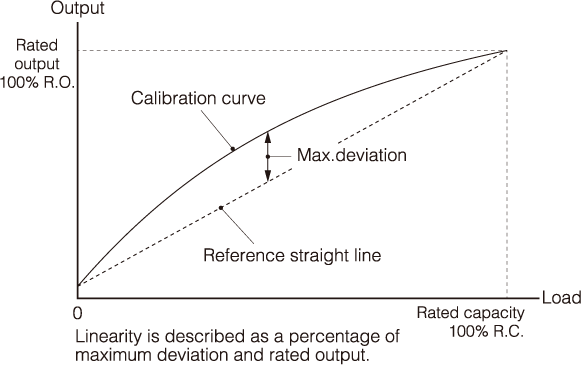
| Linearity (JIS B 7602) |
The maximum deviation of the calibration output curve from the straight reference line connecting the no-load output and rated-load output. Measured only during increasing load conditions. Expressed as a percentage of rated output.
|
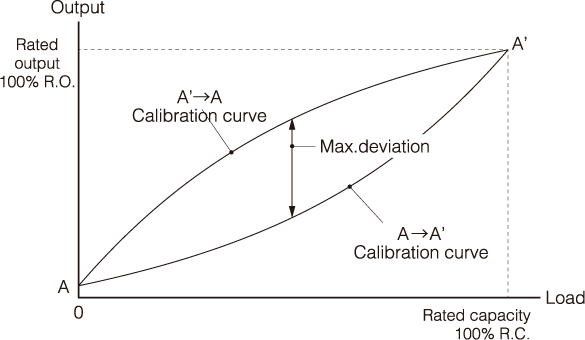
| Hysteresis | The maximum difference between outputs measured during increasing and decreasing load cycles from no-load to rated capacity. Expressed as a percentage of rated output.
|
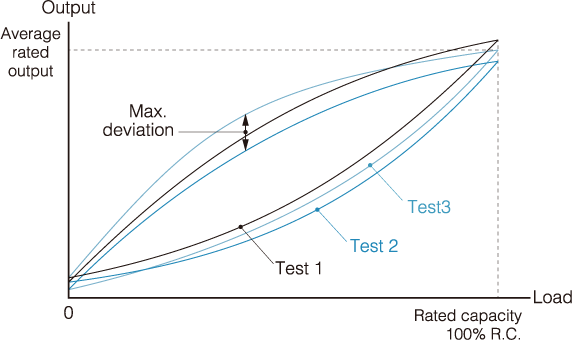
| Repeatability | The maximum difference when repeatedly loaded under the same load conditions and the same ambient conditions, expressed as a percentage of the average rated output over three cycles.
|
| Safe Excitation Voltage | The maximum voltage that can be applied to the input terminal of a load cell to maintain its specifications for continuous use. |
| Input terminal resistance | Resistance between input terminals to be measured under no load and with output terminals open. |
| Output terminal resistance | Resistance between output terminals to be measured under no load and with output terminals open. |
| Insulation Resistance | This is the DC resistance between the electrical circuit of the load cell and the load cell itself. Usually 50VDC is used for measurement. |
| Compensated temperature range | The temperature range over which the rated output and zero balance are compensated so as not to exceed the specifications. |
| Operating Temperature Range | Temperature range in which the product can be used satisfying the specifications |
| Allowable Temperature Range | A temperature range within which load cells can be used without permanent characteristicchange (damage), although the specified specifications are not me |
| Temperature Effect on Zero Balance | This is the change in output at no load when the ambient temperature of the load cell changes by 10°C. The change per 10°C is expressed as a percentage of the rated output. (ex. 0.5%R. O./10°C |
| Temperature Effect on Output | This is the change in rated output when the ambient temperature of the load cell changes by 10°C. The change per 10°C is expressed as a percentage of the rated output. The in-house inspection standard is 25°C/4 hours → 50°C/4 hours → 25°C/4 hours |
| Zero Balance | The output signal under no-load conditions. |
Other Definitions
| Term | Definition |
|---|---|
| Active Gauge | A strain gauge attached to the part that produces strain. |
| Signal-to-Noise Ratio (S/N Ratio) | Ratio between the specified output and noise (p-p value) at the set sensitivity. It is expressed in percentage or decibels(db). |
| Sensitivity | The ratio of output (voltage, current, indicated value) to strain input or vice versa under specified conditions. |
| Base Noise | The amount of noise an amplifier, indicator, or signal conditioner has. |
| Gauge Bridge / Bridge | A Wheatstone bridge circuit with a strain gauge as a constituent edge. |
| Gauge Factor Setting Range | The range of strain gauge factor that can be set to obtain the same strain value at the same load regardless of the difference in the gauge factor of the strain gauge used. |
| Calibration Strain | This is an electrical signal added to calibrate the measured value of an indicator, amplifier, etc. It is usually input in strain conversion. |
| Calibration Bridge | A bridge circuit that generates calibration strain. |
| Maximum Output | The maximum output that can be supplied while meeting specifications under a defined load. Expressed as voltage or current. |
| Output Load Resistance | Relationship between load and maximum output. |
| Switch Box | This instrument is used to switch gauges and perform balancing when measuring strain at multiple points by switching a single strain measuring instrument |
| Span | In an indicating instrument, it is the amount of strain shown in full scale. It is also sometimes called a range |
| Dial Bridge | In zero method measuring instruments, a balanced voltage generating bridge circuit with an indicator dial for strain reading. |
| Dummy Gauge | A gauge used only as a resistance for thepurpose of constructing a bridge. Also includes those used as temperature compensation to counteract changes in the amount of strain in an active gauge due to changes in temperature |
| Equivalent Noise | Noise (p-p value) at the specified output of the set sensitivity. Shown as strain converted to input. |
| Equivalent Strain | The output voltage produced by the strain applied to the gauges that make up the bridge is converted to the strain of the gauges on one side that give the same output. |
| Strain Input | This is the input of the strain meter shown in strain. |
| Load Resistance | This resistor is capable of satisfying the specifications and loading |
| Bridge Excitation | The applied power source of the bridge circuit. Voltage or current (in the case of a constantcurrent power supply), DC or AC. In the case of AC, its frequency (carrier frequency) is also indicated. |
| Bridge Box | This instrument is used to construct a Wheatstone bridge circuit in the vicinity of an active gauge |
| Resolution | It is the smallest amount of strain change that an indicator or measuring instrument can detect or adjust. |
| Balance Adjustment Range | The range within which the resistance and capacitance deviations of the gauge bridge circuit can be corrected. The resistance adjustment range is shown as a percentage of the gauge resistance (enter the gauge resistance), and the capacitance adjustment range is shown as a capacitance value. |
| Serial Number | Unique identification number of the load cell. It is written on the main unit. |
| Remote Sense | The 6-wire (remote sense) method is a connection method that compensates for voltage drops caused by cable extension and voltage changes due to temperature fluctuations. We recommend using the 6-wire connection for systems installed outdoors or in other environments where temperature fluctuations are expected, as well as in cases where overall accuracy is required. |
